The first decision when a warning light appears on a Bristol driveway

An engine ABS SRS transmission scanner is worth considering when you need to read more than basic engine codes. If the light relates to braking, airbag/SRS or transmission behaviour, a simple engine-only reader may leave you with the same uncertainty you had before plugging in. A four-system tool such as the TOPDON AD500-A is documented to access Engine, ABS, SRS and Transmission diagnostics, pull DTCs, show explanations, erase DTCs after repair on cars made in 2005 and newer, and display live data. That makes it a starting-point tool, not a repair guarantee.
The practical answer is this: plug in, identify which system is reporting a fault, record the code and explanation, and avoid clearing anything until you understand what work has been done. On a family car needed for the school run, a van needed for tomorrow’s job, or a used car being viewed before payment, the value is not magic diagnosis. It is turning a dashboard lamp into a more specific conversation: engine management, ABS, SRS or transmission, with reportable evidence rather than memory and guesswork.
Why four-system access matters before an MOT retest
UK drivers often start looking for a scanner when the timing is awkward: an MOT booking is close, a retest window is shrinking, or a warning lamp has returned after a part was changed. Engine-only readers can be useful for emissions-related faults, but they are the wrong tool if the anxiety is an ABS light, airbag/SRS light or transmission warning. The documented position of the TOPDON OBD2 Scanner AD500-A is that it is a four-car-system code reader covering Engine, ABS, SRS and Transmission, which is the key distinction for this search.
That does not mean every warning is solved at home. It means the owner can separate the first question from the repair question. At a small independent workshop in Leeds, or on a driveway in Bristol before calling a garage, the first question is: which system is complaining, and what code context exists? Once that is known, a driver can describe the fault area more clearly, decide whether a capable home repair is realistic, or stop treating the light as something to clear and hope away.
Checks to make against the documented AD500-A facts
The most important check is compatibility. The public copy says the scanner covers all OBD2 tests for 67 manufacturers and 10,000+ models, and is compatible with the majority of 1996 and newer OBDII-compliant automobiles across North America, Europe and Asia. It also says to make sure the OBD2 scanner is compatible with your vehicle before buying. For a UK buyer, that means checking make, model and year rather than assuming the phrase OBD2 covers every module on every car.
Next, match the work to the documented functions. The AD500-A listing names 5-second one-touch AutoVIN, DTC library explanations, 4-in-1 graphic live data, real-time car battery voltage monitoring, an Android 11.0 interface, 32GB ROM, a 5-inch touchscreen, rubberised buttons, WiFi lifetime software upgrades, report storage, email sharing and printable auto-generated reports. Those details matter because they shape workflow: faster vehicle selection, easier code interpretation, live-data viewing, and records you can send to a mechanic instead of trying to read numbers over the phone.
Where the scanner helps at a used-car viewing in Manchester
For a used-car buyer standing on a kerb in Manchester, the scanner’s job is to add evidence, not to replace judgement. A clean dashboard does not prove there are no stored or pending clues, and a code does not prove the exact failed part. If the seller agrees to a scan, a four-system tool gives you a broader look than a basic engine reader because costly or serious concerns may sit outside the engine module. ABS, SRS and transmission access are especially relevant on older or higher-mileage cars.
A sensible viewing sequence is to ask permission clearly, scan before the test drive, note the system and code explanation, drive only if the car is otherwise appropriate to inspect, then scan again afterwards. Use the result to decide whether to walk away, negotiate, or book a professional inspection. If a seller refuses any scan, that is not proof of a hidden fault, but it is useful context. The scanner supports a decision; it should not become the only decision-maker.
Mismatches that should stop a rushed purchase
Do not buy a four-system scanner expecting it to perform every workshop function. The documented facts here cover Engine, ABS, SRS and Transmission diagnostics, OBD2 test modes, live data, DTC explanations, AutoVIN, battery voltage monitoring, reports and WiFi updates. They do not document specialist programming, advanced service resets, coding, calibration, guaranteed manufacturer-level coverage, or a promise that every fault can be fixed from the driveway. If those are the jobs you need, this product information does not support that claim.
It is also a mismatch if you mainly want a cheap device to clear lights before an MOT without repair. The copy says DTCs can be erased to turn off warning lights after repair for cars made in 2005 and newer. The phrase after repair is important. Clearing a fault without addressing the cause can remove useful evidence and may create false confidence if the light returns later. A better buyer is someone who wants to understand the fault area, keep records, and decide the next mechanical step responsibly.
A practical warning-light checklist for the bench or driveway
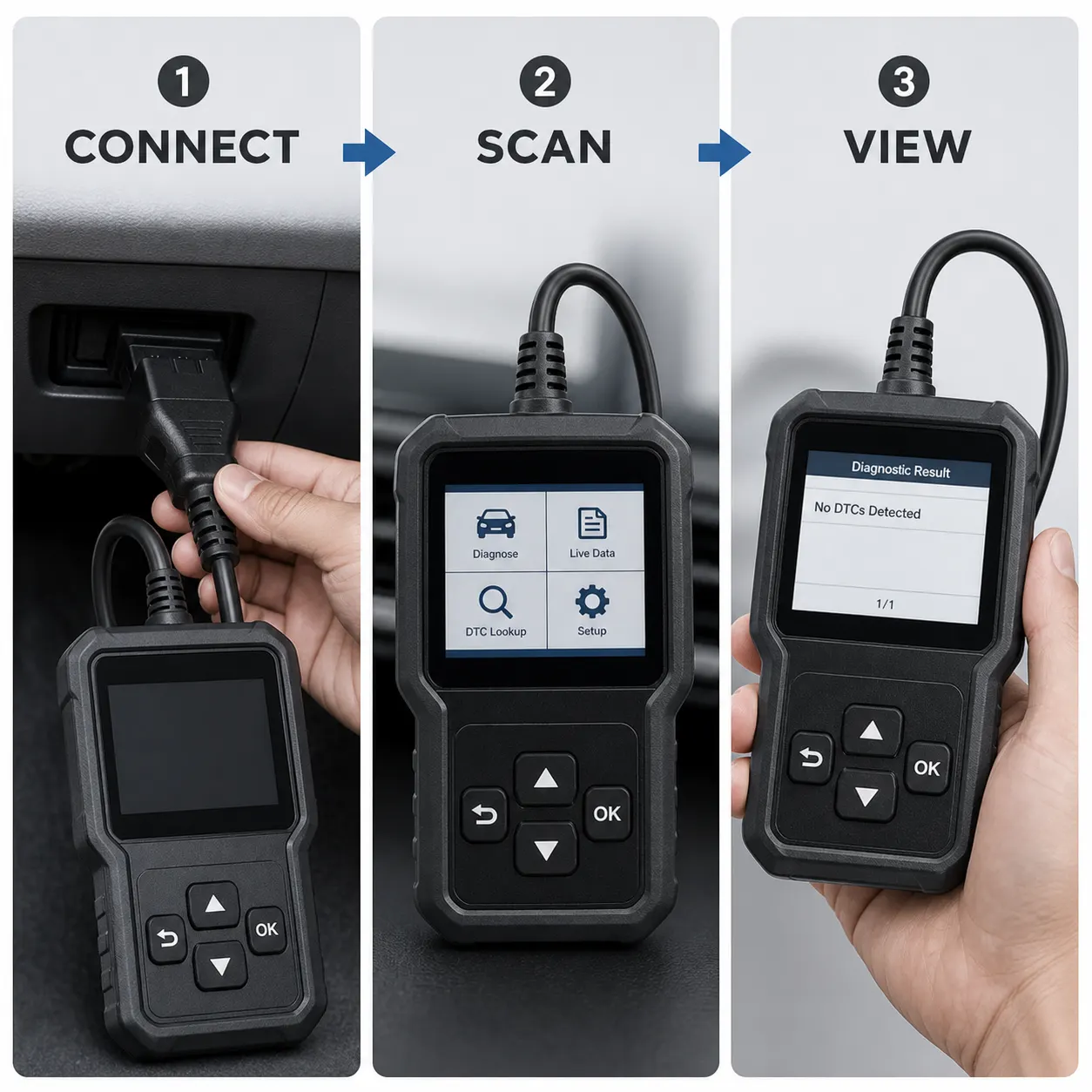
Use this working checklist at a Bristol driveway, a shared family parking space, or a small workshop bench. First, confirm the vehicle’s make, model and year against compatibility guidance before relying on the tool. Second, connect the scanner and let AutoVIN help identify the vehicle where supported. Third, scan the four relevant systems: Engine, ABS, SRS and Transmission. Fourth, read the DTC explanation rather than only the code number. Fifth, view live data where it helps the symptom, especially if the fault is intermittent or related to running behaviour.
Then record before changing anything. Save the diagnostic report in the scanner’s onboard memory, and use the documented email sharing or printable report function if a mechanic needs to see it. Check real-time battery voltage as part of the context, because low or unstable voltage can complicate diagnosis. Only erase DTCs after the repair or corrective work has been completed, and keep the old report so you can compare whether the same issue returns. This sequence reduces guesswork without pretending the scanner is a full workshop diagnosis.
How to compare it with a basic code reader
The fair comparison is not whether the TOPDON AD500-A is cheaper or dearer than every other scanner; the useful comparison is what problem each tool can see. A basic reader may be enough when you only need simple engine fault codes. The documented AD500-A configuration is aimed at buyers who need access to Engine, ABS, SRS and Transmission, plus live data graphs and reports. That makes it more relevant when warning lights involve braking, airbag, transmission or repeated household-car problems.
The interface also changes the buying decision. A standalone 5-inch touchscreen with rubberised buttons, Android 11.0, 32GB memory and up to 10 hours of battery life is a different working style from a phone-dependent dongle. For some buyers, a phone app is acceptable. For a serious home mechanic, a small operator, or someone helping family members, stored reports and shareable output may matter more than the lowest upfront price. The right choice depends on whether you need repeatable records or only an occasional engine-code check.
The grounded next step before you buy or book a garage
Before buying, write down the exact vehicle or vehicles you expect to scan: make, model, year and the warning lights you care about. Then check those against the documented compatibility advice, with particular attention to whether your concern sits in Engine, ABS, SRS or Transmission. If your main problem is outside those systems, or needs specialist reset and calibration functions not documented here, pause and choose a more appropriate diagnostic route.
If the fit looks right, treat the scanner as a better first conversation with the car and the garage. Use it to capture codes, explanations, live-data context and a report before parts are ordered or faults are cleared. For a UK driver facing an MOT retest, a used-car viewing, or another warning light on the same family fleet, that evidence is the useful outcome: clearer decisions, fewer vague phone calls, and less temptation to replace parts based on a dashboard symbol alone.